


A septic system ages one part at a time. The tank can still be sound while a baffle has broken off, a pump is tiring, or the field has started to seal. Knowing which part you are really asking about is the first step to a straight answer.
A properly designed, installed, and maintained septic system should operate for 20 to 40 years or more, according to Nebraska Extension. That range assumes the system was built right and looked after.
The EPA’s fact sheet on septic tank and soil absorption systems shows the other side. Because most household systems are not well maintained, it says their functioning life is typically 20 years or less.
So the honest answer depends on the parts. A sound concrete tank, a working distribution box, a healthy field, and any pumps or treatment units each wear out on their own schedule, and Wantage ground speeds some of them up.
At Excavating New Jersey LLC, we install, repair, and replace septic systems across Sussex and Morris counties from our shop on County Road 565, and we have worked this valley for nearly 20 years. We look at each part of a system before anyone talks about its age.
If you are buying, selling, or just wondering how much time your system has left, contact us and we will look at the parts that actually decide it.
Quick Summary
- Typical lifespan: 20 to 40 years or more for a properly designed, installed, and maintained system, per Nebraska Extension.
- The other side: the EPA says most household systems are not well maintained, so their functioning life is typically 20 years or less.
- It goes part by part: the tank, baffles, distribution box, pumps, and field each wear on their own schedule.
- Mechanical parts go first: NC State Extension puts the air-producing devices on aerobic units in the 3 to 7 year range.
- The Wantage factor: high water on creek bottomland, fast-draining gravels, and bedrock toward the High Point ridge all change how long a system lasts.
- When a part fails: New Jersey treats replacing components as an alteration, and an alteration generally has to meet new-system rules.
How Long Does Each Part of a Septic System Last?
Each part of a septic system has its own lifespan, so one failed part does not mean the whole system is done. Published sources give firm year ranges for the system as a whole, but not for most single parts. For those, what matters is what wears each part out, and that is what an inspection looks for.
Our septic installation page notes that the drainfield is usually the first component to need replacement, due to gradual soil clogging, while concrete septic tanks can last 40 years or more. The sections below take each part in turn.
The Septic Tank
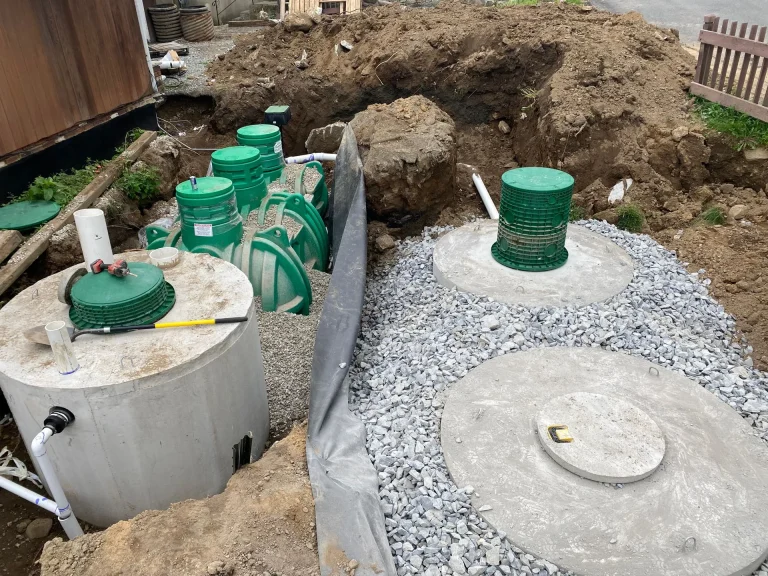
The tank is usually the longest-lived part of the system. How long it lasts depends mostly on what it is made of and how well it was built and set.
NC State Extension warns that concrete that was not mixed properly, or a tank that was not properly cured, can seriously shorten tank life. It adds that some concrete designs, such as two-piece tanks, are likely to leak.
Plastic tanks have their own weak points. The same NC State publication notes that they may collapse under the weight of the soil above them, and may begin to float when groundwater runs high, which matters on wet Wantage lots.
Baffles and the Outlet Filter
Baffles are small parts with a big job. The EPA explains that outlet baffles keep the scum layer from moving into the soil absorption system, so a missing or broken baffle lets material through that the field was never built to take.
That is why Nebraska Extension tells homeowners to check that baffles or tees are in place and working. NC State Extension describes an effluent filter or screen at the outlet as a way of increasing the life expectancy of the system.
A broken baffle is a repair job on its own. Left alone, though, it can shorten the life of the field downstream.
Pumps and Aerobic Treatment Units
NC State Extension puts the typical life of the air-producing devices on aerobic treatment units in the 3 to 7 year range.
For pump systems, the same source says failures are typically related to the life expectancy of pumps and controls. When they fail early, it points to a poor choice of supplier or the wrong type of pump for the job.
If your property runs an aerobic unit such as the ones on our Singulair Green page, expect the air-producing parts and controls to need service or replacement well before the tank does.
The Distribution Box
The distribution box splits effluent evenly across the field. When it tilts, one part of the field takes most of the flow and wears out first.
Our septic repairs page notes that frost heave frequently damages distribution boxes and rigid pipe connections in this region. A level, sound box helps the whole field last.
The Drain Field
The field is where most systems end. The EPA’s fact sheet puts the service life of a properly maintained soil absorption system in excess of 20 years.
We covered the field on its own in our post on how long a septic drain field lasts, including the biomat that slowly seals the soil and the signs a field is near the end.
What Shortens a Septic System’s Life on Wantage Ground?
Ground and water decide a lot of what happens to a system here. Our Wantage page explains that the township sits in the Kittatinny Valley, where glaciers left stratified stony sand and gravel in some places and dense till in others.
That mix means two lots on the same road can age a system very differently. Here is how each condition works against a system.
High Water Along the Creeks
On the bottomland along the Papakating Creek, our Wantage page calls the seasonal high water table the whole design problem. A field with too little dry soil under it has less room to treat effluent.
High groundwater matters for plastic tanks too, which NC State Extension warns may begin to float in those conditions. Our Wantage page adds that getting surface water under control is often the cheapest thing a homeowner can do to protect a system that still has years left in it.
Fast-Draining Gravels
Wantage’s stratified sands and gravels are highly permeable, according to our Wantage page. It explains that effluent needs enough soil contact to be treated before it reaches groundwater, and in fast-draining material that treatment window shrinks.
That makes gravel a design question as much as a wear question, and it shapes what a replacement on that lot has to look like.
Shallow Bedrock Toward the Ridge
Toward the High Point ridge and the Route 565 corridor, our Wantage page notes that bedrock comes up close to the surface. A field squeezed into too little soil has less margin from the start.
Overloading, Compaction, and Frost
Some of what shortens a system is in the homeowner’s hands. NC State Extension says periodic overloading definitely lessens the life expectancy of a system, and that low-flow fixtures lengthen it by giving it less to handle.
The same publication warns that destroying the soil structure through compaction or smearing will take years off a system. Our post on hydraulic overload versus biomat failure in Sussex County soils covers how too much water and a sealed field show up differently.
How Do You Know When a Septic Tank Needs to Be Replaced?
A tank needs replacing when the structure itself has failed, not when one part inside it has. Cracks, leaks, a collapsing lid, or a tank that is too small for the house are structural. A missing baffle or a clogged filter is a repair.
Our septic installation page notes that when a septic inspection reveals structural problems, undersized systems, or outdated technology, local health departments issue notices requiring replacement as a condition of sale.
Signs That Point to a System Problem
Our septic repairs page lists the problems we see most: slow drains throughout the house, wet spots or standing water over the drainfield during dry weather, and sewage odors near the tank. They point to a system that needs a closer look, but they do not tell you on their own which part has failed.
Our guide to early warning signs your septic system is headed for trouble sorts those signs by how urgent they are.
Why an Inspection Answers the Age Question Better Than a Date
An installation date tells you how old a system is. It does not tell you how much life it has left, because the same age can mean a sound system or a failing one.
An inspection looks at the tank structure, the baffles, the distribution box, and the field one at a time. That is the only way to know whether you are looking at a repair or a replacement.
Can a Septic System Last Longer Than 40 Years?
Yes, the main structures can last longer than 40 years if they were built right and looked after. The EPA’s fact sheet on septic tank and soil absorption systems says conventional septic systems are designed to operate indefinitely if properly maintained, which is a design goal, not a promise for any one system.
The published ranges stop short of that. Nebraska Extension gives 20 to 40 years or more, and our septic installation page notes that concrete septic tanks can last 40 years or more. Parts like baffles, pumps, and controls will still need attention along the way.
What Happens When an Old System Needs Work in New Jersey?
When a part of an older system fails, the fix is not always a simple swap. New Jersey’s septic rules define an alteration to include replacing system components, and the owner has to get prior approval from the local health authority for any repairs or alterations.
Under N.J.A.C. 7:9A-3.3(e), an alteration generally has to meet the requirements of a new system, with the exceptions the rule lists. The same section says any alteration to a disposal field is the practice of professional engineering.
Why an Old Design Often Cannot Be Rebuilt As It Was
Our septic installation page puts it plainly: replacement systems must meet current code standards, so an outdated design cannot simply be rebuilt. It gives the example of a 1960s system with a 500-gallon tank, where current code requires 1,000 gallons for the home size.
On Wantage ground, that often means the new field needs engineering. Our post on why you might need an engineered septic system in Wantage walks through when that happens, and our septic engineering and design team handles the soil testing and plans.
What Replacement Typically Costs
Our septic installation page puts complete system replacement at $18,000 to $45,000, depending on system size, site conditions, and location. Treat that as typical industry context. The price for your lot comes from a site visit.
Prices can change, so we still suggest calling us to confirm the price for your septic repair.
Our septic system installation page covers the full replacement process, from soil testing to final inspection.
Know How Much Time Your System Has Left Before a Sale Decides for You
A home sale is often when a system’s age stops being a guess, because a buyer’s inspection looks at it closely. A 30-year-old system can still be sound, and a 15-year-old one can be failing. The difference is in the parts, so that is where we look first.
We start with the system itself. Our technicians use dye testing, camera inspections, and component evaluations to find the exact failure point, whether it is a clogged filter, a damaged baffle, a tilted distribution box, or the field. Then we tell you whether you are looking at a repair or a replacement.
If a replacement is needed during a sale, our Wantage page explains that pay-at-closing means we complete the replacement now and are paid from the proceeds when the property sells. Our septic repairs team handles the smaller fixes when the system still has years left.
At Excavating New Jersey LLC, we give you a firm quote that holds to closing day. To get one, call us at (973) 702-0655.
Frequently Asked Questions
How many years will a septic system last in Wantage?
A properly designed, installed, and maintained septic system should last 20 to 40 years or more, according to Nebraska Extension. In Wantage, high water on creek bottomland, fast-draining gravels, and bedrock toward the ridge can shorten that, so each part of the system is worth checking on its own.
How much does it cost to replace an old septic tank?
Our septic installation page puts complete system replacement at $18,000 to $45,000, depending on system size, site conditions, and location. Treat that as typical context. In New Jersey, replacing components counts as an alteration, so the work usually has to meet current code.
Prices can change, so we still suggest calling us to confirm the price for your septic repair.
How do you know when a septic tank needs to be replaced?
A tank needs replacing when its structure has failed, such as cracks, leaks, or a collapsing lid, or when it is too small for the house. A missing baffle or clogged filter is usually a repair. An inspection that checks each part is the way to tell them apart.
Can a septic tank last 50 years?
It can, if it was built well and looked after. The EPA says conventional septic systems are designed to operate indefinitely if properly maintained. The published ranges stop at 20 to 40 years or more, and parts like baffles and pumps will need attention along the way.
What is the most common cause of septic system failure?
Lack of upkeep is the most common reason systems fall short. The EPA says most household systems are not well maintained, so their functioning life is typically 20 years or less. NC State Extension adds that periodic overloading definitely lessens the life expectancy of a system.
Does replacing one part of a septic system trigger new rules in New Jersey?
It can. New Jersey’s septic rules count replacing components as an alteration, and under N.J.A.C. 7:9A-3.3(e) an alteration generally has to meet new-system requirements, with listed exceptions and engineering required for any change to the disposal field.
Does adding a bedroom affect an old septic system?
Often, yes. Our septic installation page notes that systems are sized based on bedroom count and daily wastewater flow, and that finishing basements, adding second floors, or converting seasonal cottages to year-round homes often trigger replacement requirements during the building permit process.
Is it cheaper to fix one part than replace the whole system?
Usually, yes. Our septic repairs page puts distribution box leveling at $800 to $1,500 and says simple repairs like baffle replacement or box leveling take one to two days. Complete replacement runs $18,000 to $45,000, so finding the failed part first matters.
Prices can change, so we still suggest calling us to confirm the price for your septic repair.
 Why Would I Need an Engineered Septic System in Wantage?