
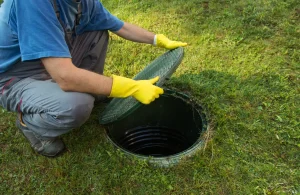

Picture a conventional septic tank with a small treatment plant built into it. That is close to what a Norweco Singulair system is: one tank, several chambers, and an aerator that feeds oxygen to the bacteria doing the work.
A Norweco septic system cleans wastewater in stages before it ever reaches the soil. It settles out what will not break down, adds air so aerobic bacteria can digest the rest, lets the treated liquid settle and filter, and only then sends it to the field.
That extra treatment is why these units show up on lots where a conventional field struggles. In Wantage, that usually means high water on creek bottomland or rock close to the surface.
At Excavating New Jersey LLC, our crew are certified Norweco installers. We put in the complete Bio-Kinetic aerobic system, from the ribbed plastic tank and Singulair aerator to the Service Pro control panel with remote monitoring.
If you are weighing a Norweco system for your lot, or you just bought a house that has one, contact us and we will walk you through how yours is set up.
At a Glance
| Stage | What Happens | What Does the Work |
|---|---|---|
| Pretreatment | Material that will not break down stays behind; the rest flows on | Gravity and anaerobic bacteria |
| Aeration | Aerobic bacteria convert the waste into stable substances | The Singulair aerator on a time clock |
| Clarification | Solids settle and are sent back for more treatment | Gravity and the Bio-Static sludge return |
| Filtration | Liquid is filtered, settled, and released at an even rate | The Bio-Kinetic system |
| Dispersal | Treated effluent goes to the field | The soil, often in a smaller field |
How Wastewater Moves Through a Norweco System, Step by Step
A Norweco Singulair system treats wastewater in one tank divided into chambers, and each chamber has a single job. Norweco’s own owner’s manual and service instructions describe the order: pretreatment, aeration, clarification, and filtration, with treated effluent leaving for the field at the end. Here is what happens at each step.
Step 1: The Pretreatment Chamber Holds Back What Will Not Break Down
Everything from the house enters the pretreatment chamber first. Norweco’s owner’s manual explains that anaerobic bacterial action combines with gravity here to precondition the waste before it moves on.
Norweco’s service instructions add that this chamber is designed to retain non-biodegradable solids and let biodegradable solids flow into the aeration chamber. Grease, wipes, and other material the bacteria cannot digest are meant to stay put.
That is why what goes down the drain still matters with a treatment unit. Material that gets past this chamber shows up later as a problem in the aeration and clarification chambers.
This chamber is also where a technician looks to see how much has built up. Norweco’s service instructions call for the pretreatment chamber to be evaluated by a factory-trained technician at least every three years.
Step 2: The Aerator Feeds Oxygen to the Bacteria

The aeration chamber is where most of the treatment happens. Norweco calls this the extended aeration process, and according to its manual, aerobic bacteria use the organic matter in the wastewater to biologically convert the waste into stable substances.
Those bacteria need air. Fresh air enters the aerator through intake ports under its handle, and a vent cast into the access cover above it supplies the air the aerator draws into the wastewater.
The aerator does not run all the time. Norweco says its time clock is factory set to run 30 minutes per hour and should only be adjusted by an authorized service provider. Our Singulair Green page puts the running cost at roughly $10 to $15 a month, about what a 100-watt bulb uses.
The aerator is also built with high water in mind. Norweco’s manual notes that it is not designed to run under water and shuts itself off if a high water condition occurs.
Step 3: The Clarifier Lets Solids Settle and Sends Them Back
From aeration, the flow moves into the clarification chamber, where gravity settles out biologically active material. The liquid near the top is now much cleaner than what came in.
The settled material is not wasted. Norweco’s Bio-Static sludge return uses gentle hydraulic currents to carry settled particles back to the aeration chamber for more treatment, without stirring up the clear liquid on its way out.
This chamber gets hands-on attention at service visits. Norweco’s service instructions have the technician gently scrape the clarification chamber’s side walls while the aerator runs, so material that clings to them is carried back for treatment.
Step 4: The Bio-Kinetic Filter Polishes and Evens Out the Flow
Before anything leaves the tank, it passes through the Bio-Kinetic system. Norweco’s manual describes it as a non-mechanical device with 3 separate filtration zones and 8 independent settling zones, where the liquid is filtered, settled, and flow equalized.
Flow equalization matters because households do not send water out evenly. During a surge, such as laundry and showers at the same time, the Bio-Kinetic system holds wastewater upstream of the outlet, which Norweco says preserves treatment integrity.
The same device can also disinfect. Norweco’s manual says that when it is used with Blue Crystal disinfecting tablets, the Bio-Kinetic system’s performance as a disinfection device is certified to NSF/ANSI Standard 46, Section 11. The Singulair system itself, the manual adds, meets all requirements of NSF/ANSI Standard 40.
Step 5: Treated Effluent Goes to a Smaller Field
The effluent that leaves a Norweco tank still goes into the ground, but it arrives much cleaner than effluent from a conventional tank. That changes what the field below it has to do.
Our septic installation page notes that aerobic treatment units reduce drainfield size requirements by 50% or more. New Jersey’s septic rules also allow the four-foot zone of treatment under a field to be reduced, at the local authority’s discretion, to a minimum of 18 inches when the design includes an advanced wastewater pretreatment device.
What Keeps It Running, and What New Jersey Requires
A Norweco system keeps working because it is checked on a schedule and watched by its own controls. New Jersey also requires owners to keep a service provider under contract for as long as the system is in use, so the service side is part of owning one.
Alarms and Monitoring
The Service Pro control center watches the aerator. Norweco’s manual says that if it detects a problem, the red alarm light flashes and the control center tries to restart the aerator every five minutes for two hours.
If the aerator still does not restart, an audible alarm sounds. With the optional Service Pro MCD monitoring, connected and covered by a remote monitoring agreement, Norweco says your service provider is notified immediately of any alarm condition.
Service Inspections
Norweco includes semi-annual service inspections for the first two years in the original purchase price. At each one, the manual says the effluent is checked for color, turbidity, scum overflow, and odor, and the Bio-Kinetic system is removed and cleaned or swapped for a clean unit.
You will see the visit, not just hear about it. Norweco’s service checklist ends with a 3-part service record, with the owner’s copy hung on the front door and the record entered into Norweco’s online system.
After those two years, Norweco says continued service is at the owner’s option. In New Jersey, the state rules make it more than an option.
The New Jersey Service Contract Rule
Under N.J.A.C. 7:9A-12.3, the owner of a system that includes an advanced wastewater pretreatment device must have a service contract in place, throughout the life of the system, with an authorized service provider. Renewal contracts have to run at least one year.
Letting it lapse is not a paperwork detail. The same rule says failure to have a valid service contract is a violation of the Water Pollution Control Act, and each day without one counts as a separate violation.
When a Norweco System Makes Sense on a Wantage Lot
A treatment unit earns its place where the ground cannot do enough of the treatment on its own. Our Wantage page notes that a property near the Papakating bottomland may need a raised bed or an advanced treatment unit to get the required separation from the water table.
Rock is the other common reason. Toward the High Point ridge and the Route 565 corridor, our Wantage page explains, bedrock comes up close to the surface, which leaves less soil under a conventional field. The 18-inch option for advanced pretreatment is one way a design can work with that kind of shallow ground.
Access can matter as much as soil. Our Singulair Green page notes that on lakefront lots where concrete trucks cannot reach the backyard, the lightweight tank can be hand-carried or light-machined into place without destroying retaining walls.
A treatment unit does not remove the need for a field or for permits. The treated effluent still goes into the ground, and the design still has to be approved like any other septic system.
Whether your lot needs one is a soil question first. Our post on why you might need an engineered septic system in Wantage explains how the soil tests decide, and our septic engineering and design team runs those tests.
Before You Commit to a Treatment Unit
A Norweco system is a good answer to hard ground, but it comes with an aerator, controls, and a service contract that a conventional system does not have. Before you choose one for your lot, it is worth getting three things clear:
- What your soil tests show: whether the lot needs advanced treatment or can take a conventional or raised field.
- Who will service it: New Jersey requires an authorized provider under contract for the life of the system.
- What it costs to run: electricity for the aerator, the service contract, and eventual aerator replacement.
Our Norweco Singulair Green installation page covers how we plan and install these systems on Northern New Jersey lots, and our septic system installation page covers the full replacement process.
When you want a firm quote that holds to closing day, call Excavating New Jersey LLC at (973) 702-0655.
Frequently Asked Questions
How does a Norweco septic system work in Wantage?
A Norweco system treats wastewater in stages inside one tank. A pretreatment chamber holds back what will not break down, an aerator feeds oxygen to bacteria that digest the waste, a clarifier settles the solids, and a Bio-Kinetic filter polishes the flow before it reaches the field.
How much does a Norweco septic system cost?
Our Singulair Green page puts most residential installations at $15,000 to $30,000, depending on complexity. Treat that as typical context. The price for your property depends on the soil tests, the site, and access, so it comes from a site visit.
Prices can change, so we still suggest calling us to confirm the price for your septic work.
How long does a Norweco system last?
The tank and chambers are built for the long run, but the moving parts wear sooner. NC State Extension puts the typical life of air-producing devices on aerobic units at 3 to 7 years, and Norweco lets owners exchange an aerator of any age at a prorated cost. Our post on how many years a septic system will last covers the rest of the system.
Do I need a maintenance contract for a Norweco system in New Jersey?
Yes, N.J.A.C. 7:9A-12.3 requires the owner of a system with an advanced wastewater pretreatment device to keep a service contract with an authorized provider for the life of the system. Renewals run at least one year, and a lapse counts as a violation.
What happens if the Norweco alarm goes off?
The control center has already tried to restart the aerator every five minutes for two hours before the audible alarm sounds. Pressing the reset button silences it and tries another restart. If the alarm condition is not resolved, Norweco’s manual says to contact your service provider.
 How Many Years Will a Septic System Last in Wantage?