
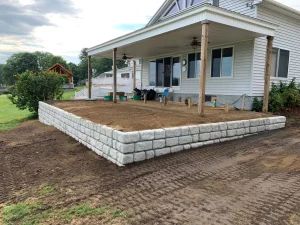
Septic System Services in New Jersey
FREE ESTIMATES | LICENSED AND CERTIFIED | FREE SITE EVALUATIONS
Get a Free Estimate
"*" indicates required fields
Serving Sussex County & Northern New Jersey
When your septic system fails—or a T-1 inspection reveals costly issues during a home sale—you need more than just an excavator or a septic pumper. You need a complete solution: engineering, permitting, installation, and restoration, all coordinated by one trusted team. Excavating New Jersey LLC is the only Sussex County contractor offering start-to-finish septic services with Pay-at-Closing options for home sellers.
Whether you’re facing hydraulic failure, a failed real estate inspection, or planning new construction on a challenging lot, we handle every phase of the project. From soil logs and engineering plans to final grading and seed, we deliver turnkey septic solutions built for Northern New Jersey’s unique conditions—rocky soil, high water tables, and strict Pinelands or Highlands regulations.
NJ DEP Licensed • Licensed Professional Engineer (PE) on Staff • 203k Loan Certified • Nearly 20 Years in Business
Our Septic Service Offerings

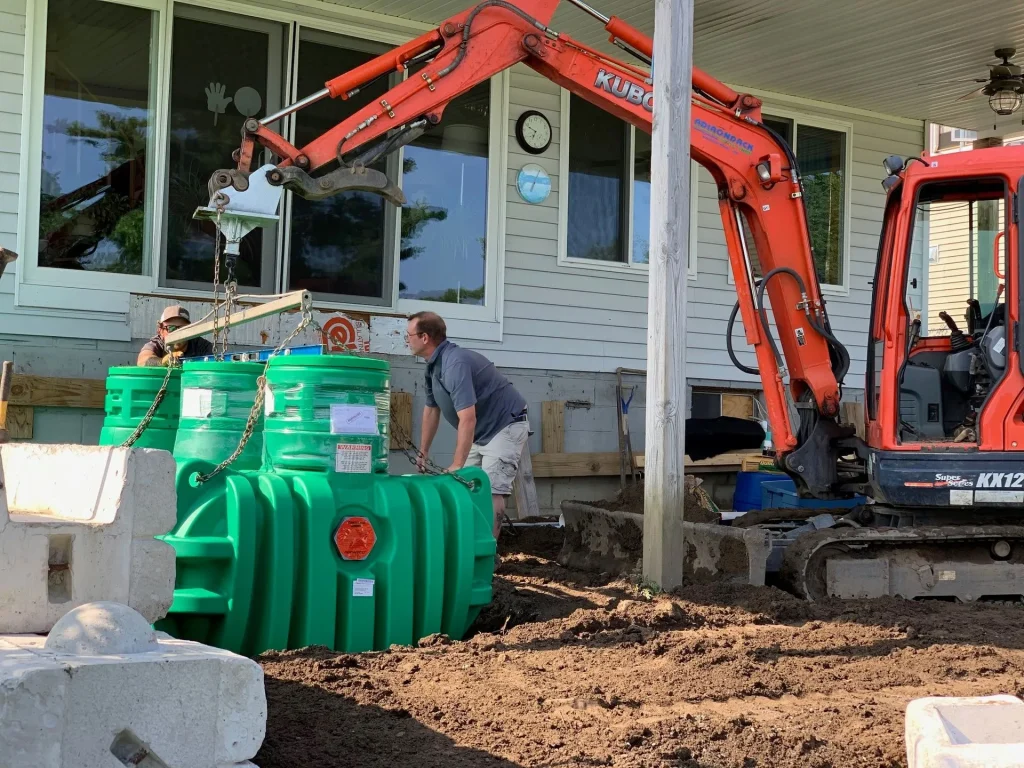
Norweco Singulair Green
When your lot is too small, too wet, or too rocky for a standard septic system, the Norweco Singulair Green gives you a …
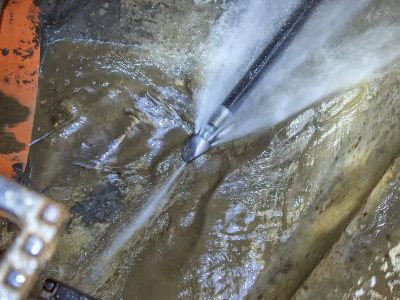
High-Pressure Water Jetting
When snaking your septic lines only provides temporary relief, professional high-pressure water jetting removes the grease, …
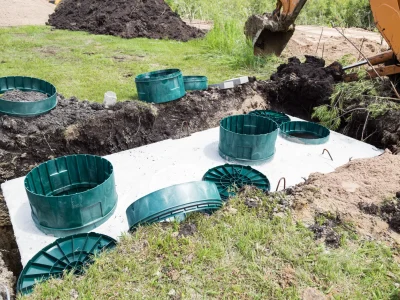
Septic System Repairs
When your septic system shows warning signs—slow drains, sewage odors, or wet spots in your yard—you need fast, accurate …
Septic Installation
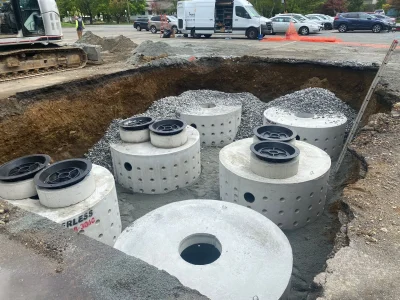
When your septic system fails or you’re facing a mandatory replacement for a home sale, you need a licensed contractor …
Why Northern NJ Homeowners Choose Excavating New Jersey LLC
Most septic projects in New Jersey require coordination between multiple contractors: a licensed engineer for the design, a separate excavation company for the installation, and often a third party for site restoration. This fragmented approach leads to scheduling delays, finger-pointing when issues arise, and cost overruns.
Excavating New Jersey LLC eliminates that chaos. We are one of the only firms in Sussex County with both in-house engineering capability and heavy excavation equipment. That means one point of contact, one timeline, and one team accountable for the entire project—from the initial soil percolation test to the final inspection.
Our team has spent nearly two decades working in Northern New Jersey’s toughest conditions. We know the rocky ledge in Wantage. We understand the seasonal high water table in Hopatcong. We’ve navigated Pinelands Commission reviews and Highlands Council approvals hundreds of times. And we’ve helped distressed home sellers close deals that were on the verge of collapse due to septic issues.
When you hire us, you’re not just getting a contractor—you’re getting a partner who understands the regulatory landscape, the local geology, and the financial stress you’re facing. We speak plainly, estimate fairly, and finish on time.
We don’t just install systems—we solve septic problems. Whether you need a custom-engineered design for a challenging lot, emergency repair for a failing system, or advanced treatment technology to meet strict environmental standards, we have the expertise and equipment to deliver.
The Start-to-Finish Septic Installation Process in New Jersey
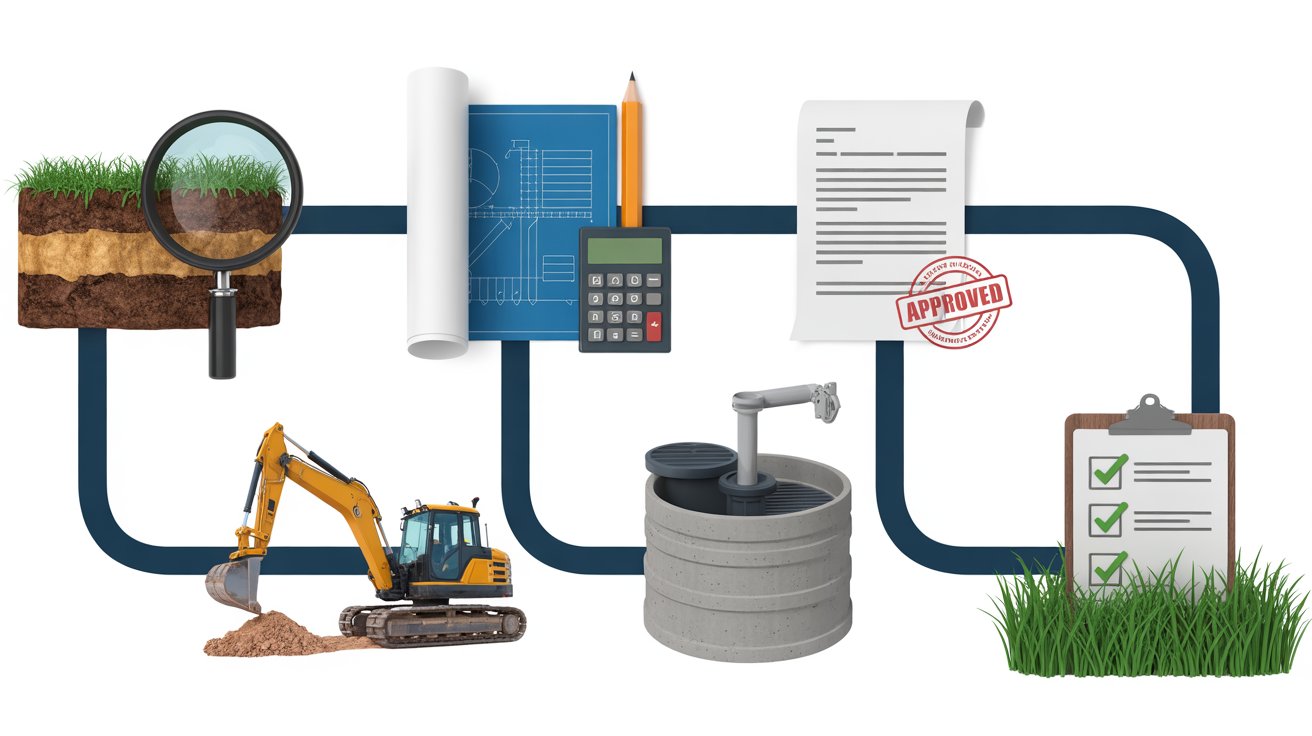
We believe transparency reduces anxiety. Here’s exactly what happens when you hire Excavating New Jersey LLC for a complete septic installation or replacement.
Step 1: The Site Evaluation & Soil Log
Before any design work begins, we need to understand your soil. Our engineer digs test pits across the proposed absorption field area, logs the soil layers, and conducts percolation tests to measure how quickly water drains. We also bail the pits and return 24-48 hours later to measure the seasonal high water table—a critical factor in New Jersey, where spring conditions can be dramatically different from summer. This data determines whether you can use a conventional in-ground system or need a mound system.
Step 2: Engineering & Custom Design
Using the soil data, lot survey, and household size (which determines daily wastewater flow), our PE designs a system tailored to your property. The design specifies tank size, drain field dimensions, pipe layout, and any special components like pump chambers or ATUs. We submit the design to the local health department and NJ DEP for approval. If you’re in the Pinelands or Highlands, we coordinate the additional environmental reviews required by those agencies.
Step 3: Permitting & Approvals
We handle all the paperwork. Most residential septic permits in Sussex County take 4-6 weeks to process, though Pinelands or Highlands projects can take longer. We stay in contact with the reviewing agencies, respond to any technical questions, and notify you the moment permits are issued. You don’t have to chase bureaucrats—that’s our job.
Step 4: Excavation & Installation
Once permitted, we schedule the build. Our excavation crew arrives with backhoes, dump trucks, and compaction equipment. We excavate the tank area and drain field trenches, set the tank (ensuring proper grade and alignment), install the distribution box and piping, and construct the absorption field with clean stone and fabric. For mound systems, we import engineered sand and build the mound to precise specifications. Most residential installations take 3-5 days, depending on weather and site access.
Step 5: Inspection, Backfill & Restoration
Before we cover anything, the local health department inspector visits the site to verify compliance with the approved design. Once the system passes inspection (and it will—we build to code every time), we backfill the excavation, grade the site to promote positive drainage away from the field, and finish with topsoil and seed. We don’t leave ruts, piles of rock, or mud pits. We restore your property so you’d barely know we were there.
Navigating New Jersey Septic Regulations: N.J.A.C. 7:9A, Pinelands & Highlands

New Jersey has some of the most stringent septic regulations in the country—and for good reason. Our high population density, critical water supplies, and sensitive ecosystems demand careful wastewater management. If you’re building or replacing a septic system in Northern NJ, you need to understand the regulatory framework.
N.J.A.C. 7:9A: The Foundation
New Jersey Administrative Code Title 7, Chapter 9A establishes the minimum standards for all individual subsurface sewage disposal systems in the state. It governs everything from tank sizing and setback distances to soil requirements and inspection protocols. All septic designs must be prepared by a licensed Professional Engineer (PE) or a Certified Public Works Manager, and all installations must be inspected by the local health department before being covered. Compliance isn’t optional—it’s the law.
Pinelands Commission Regulations
If your property is located within the Pinelands National Reserve (which covers much of Southern and portions of Central New Jersey), you face additional restrictions. The Pinelands Comprehensive Management Plan limits development density and often requires larger lot sizes or advanced treatment systems to protect the aquifer. In Pinelands Preservation Areas, conventional septic systems may not be permitted at all—you may need an ATU or a connection to public sewer. Our PE is experienced in Pinelands reviews and knows how to design systems that satisfy both NJ DEP and the Pinelands Commission.
Highlands Council Requirements
Properties in the Highlands Region (which includes much of Sussex, Warren, and Passaic Counties) are subject to the Highlands Water Protection and Planning Act. If you’re in the Preservation Area, new septic systems trigger a Highlands Applicability Determination and may require a waiver or exemption. We’ve successfully navigated dozens of Highlands reviews and understand the additional documentation and design standards required.
Local Health Department Oversight
Even after state and regional approvals, your local health department has final say. Sussex County, for example, requires soil logs witnessed by a county inspector, and some municipalities have setback requirements that exceed state minimums. We maintain strong working relationships with local health officials throughout Northern NJ, which helps keep your project moving.
The Bottom Line:
Regulations exist to protect public health and the environment. We don’t view them as obstacles—we view them as the baseline for quality work. When you hire a contractor who understands the code (and has a PE on staff to prove it), you avoid costly redesigns, permit denials, and failed inspections.
Frequently Asked Questions About NJ Septic Systems
What is the difference between a functional inspection and a regulatory T-1 inspection in NJ?
A functional inspection (often called a “visual” or “walk-through” inspection) simply checks whether the system is currently working—no backups, no surfacing effluent, no obvious failures. A T-1 regulatory inspection, required for most real estate transactions in New Jersey, is far more rigorous. It involves uncovering the tank and distribution box, verifying setback distances, checking for structural damage, and ensuring the system meets current code standards. Many systems pass functional inspections but fail T-1s due to outdated designs, inadequate sizing, or proximity violations that weren’t grandfathered.
How do the Pinelands Commission regulations differ from standard NJ DEP septic codes?
Pinelands regulations layer additional environmental protections on top of N.J.A.C. 7:9A. In Pinelands Preservation Areas, development density is severely limited, and septic systems often require advanced treatment (ATUs) to reduce nitrogen loading into the aquifer. Lot sizes must be larger, setbacks from wetlands are more stringent, and any new construction triggers a Pinelands Development Application review. In less-restricted Pinelands zones, standard septic designs may be acceptable, but you’ll still need Pinelands Commission approval before the local health department will issue a permit.
What are the signs that a drain field is suffering from hydraulic failure?
Hydraulic failure occurs when the soil in the drain field can no longer absorb wastewater at the rate your household produces it. Early signs include slow drains throughout the house (not just one fixture), gurgling sounds in the plumbing, and sewage odors near the tank or field. As failure progresses, you’ll see wet spots or standing water over the drain field—even during dry weather—and lush, dark green grass indicating effluent is surfacing. In severe cases, raw sewage backs up into the house. Hydraulic failure is usually caused by biomat buildup (a layer of organic material that clogs the soil interface), soil compaction, or a high water table that
Is it mandatory to replace a cesspool when selling a home in New Jersey?
Yes, in most cases. New Jersey law prohibits the use of cesspools, and they must be replaced with a compliant septic system when a property is sold. The only exception is if the cesspool was legally installed before the ban and the property is being transferred within a family (parent to child, etc.). For standard real estate transactions, the seller is responsible for replacing the cesspool with an engineered septic system that passes a T-1 inspection. This is one of the most common reasons home sales in rural New Jersey hit unexpected delays—and why our Pay-at-Closing option is so valuable.
How does the seasonal high water table affect septic system design in my county?
In Northern New Jersey, the water table can fluctuate dramatically between seasons. During spring snowmelt or prolonged rain, the water table may rise to within a few feet of the surface—or even above ground in low-lying areas. N.J.A.C. 7:9A requires a minimum vertical separation between the bottom of the drain field and the seasonal high water table (typically 2–4 feet, depending on soil type). If your water table is too high for a conventional in-ground system, we’ll design a mound system, which raises the drain field above grade using imported sand. This is extremely common in Sussex County, where ledge rock and high water tables are the norm.
Can a mounded septic system be landscaped to look natural?
Absolutely. A well-designed mound system blends into the landscape when properly graded and planted. We shape the mound with gentle slopes (typically 3:1 or 4:1 grade), cover it with topsoil, and seed it with a low-maintenance grass mix. Some homeowners plant wildflowers or ornamental grasses on the mound to make it a landscape feature rather than an eyesore. The key is proper construction—if the mound is built with clean sand, compacted correctly, and finished with adequate topsoil, it will support vegetation and look natural within one growing season.
What is the average lifespan of a concrete septic tank versus a fiberglass tank?
Concrete tanks, when properly installed, can last 40–50 years or more. They’re durable, heavy (which prevents flotation in high water table conditions), and resistant to damage from soil pressure. The main failure mode is cracking due to settling or root intrusion at the inlet/outlet pipes. Fiberglass tanks are lighter, easier to install, and immune to corrosion, but they can crack if not bedded properly or if subjected to heavy loads (like vehicles driving over them). Lifespan is comparable—30–40 years—but fiberglass tanks may require anchoring in high water table areas to prevent flotation. We recommend concrete for most Northern NJ installations due to soil conditions, but fiberglass is a good choice for tight access sites where crane placement is difficult.
What are the signs of a septic system failure?
Not every septic problem announces itself with a sewage backup in the basement. Often, the warning signs are subtle—until they’re not. Here’s how to distinguish between a system that needs maintenance and one that’s in true hydraulic failure.
Warning Signs of Septic System Failure:
- Persistent wet spots or standing water over the drain field, even during dry weather
- Sewage odors in the yard or near the tank
- Slow drains throughout the house (not just one fixture)
- Gurgling sounds in plumbing when you flush or run water
- Lush, dark green grass over the drain field (indicating effluent surfacing)
- Failed T-1 inspection during a real estate transaction
What’s Happening Below Ground:
In most cases, failure is caused by hydraulic overload—the drain field can no longer absorb the volume of wastewater your household produces. This can result from compacted soil (often from vehicles driving over the field), a high water table that saturates the absorption area, or simply age-related biomat buildup that clogs the soil interface. Less commonly, failure is structural: a cracked tank, a collapsed distribution box, or tree roots invading the pipes.
Maintenance vs. Replacement:
If your tank is simply full, pumping will solve the problem temporarily. But if the drain field is failing, pumping won’t help—the wastewater has nowhere to go. Our diagnostic process includes a visual inspection, a dye test (to see if effluent is surfacing), and often a camera inspection of the lines. If the field is shot, we’ll tell you. If it’s salvageable, we’ll tell you that too. We’ve been doing this long enough that we don’t need to upsell you on a $30,000 replacement if a $3,000 repair will buy you five more years.
How much is a septic replacement so expensive in Northern NJ?
Let’s address the elephant in the room: septic system replacement is expensive. In Northern New Jersey, a complete installation typically ranges from $25,000 to $45,000, depending on system type, site conditions, and regulatory complexity. That’s not a trivial expense—especially if you’re a home seller who just learned about the problem during a T-1 inspection.
What Drives the Cost?
- Engineering & Permitting: $3,000–$6,000 (soil testing, design, submissions, inspections)
- Materials: $5,000–$10,000 (tank, piping, stone, sand for mounds, ATU equipment)
- Excavation & Labor: $12,000–$20,000 (digging, hauling, installation, grading)
- Site Restoration: $2,000–$5,000 (topsoil, seeding, repair of driveways or landscaping)
- Regulatory Complexity: Pinelands or Highlands projects add $2,000–$8,000 in additional engineering and review fees
Rocky soil (common in Sussex County) increases excavation time. High water tables require mound systems, which use more material. Limited site access means smaller equipment and more manual labor. Every property is different, which is why we provide free, flat-rate estimates after a site visit—no surprises, no change orders.
The “Pay-at-Closing” Solution
If you’re selling your home and a failed T-1 inspection is threatening your deal, we offer a game-changing option: Pay-at-Closing financing. We complete the entire septic installation—engineering, permitting, excavation, restoration—and you pay us at the closing table when the house sells. No upfront cash. No interest (for qualified projects). Just the peace of mind that the work gets done and your sale moves forward.
We also work with buyers using FHA 203k Rehabilitation Loans, which allow the septic replacement cost to be rolled into the mortgage. Our team is experienced in providing the documentation and timelines lenders require for these programs.
Is It Worth Repairing Instead?
Sometimes, yes. If the tank is sound and the failure is limited to a single line or distribution box, a repair might cost $3,000–$8,000 instead of a full replacement. We’ll always give you an honest assessment. But if the drain field is saturated or the tank is cracked, rep air is just delaying the inevitable—and in a real estate transaction, the buyer’s lender won’t accept a band-aid fix.
How long does the typical project take?
We know you’re worried about the mess. You’re picturing your yard torn apart, trucks everywhere, and months of chaos. Here’s the reality:
Typical Project Timeline:
- Soil Testing & Engineering: 1–2 weeks
- Permit Review: 4–8 weeks (longer for Pinelands/Highlands)
- Installation: 3–5 days
- Final Inspection & Restoration: 1–2 days
- Total (Soil to Seed): 6–12 weeks
Most of that time is waiting for permits—not active construction. Once we break ground, we move fast.
Site Disruption:
Yes, we’ll have heavy equipment on your property. Yes, there will be excavation. But we take site protection seriously. We use equipment mats to prevent lawn damage where possible. We coordinate with you on access routes to avoid gardens, septic systems for neighboring properties, or utility lines. And we don’t leave the job site until it’s clean—no rock piles, no ruts, no half-filled holes.
Restoration Commitment:
After the system passes inspection, we grade the site to match existing contours (or improve drainage if needed), spread topsoil, and seed disturbed areas. In most cases, grass is growing within 2–3 weeks. If we damage a driveway apron or walkway during excavation, we repair it. We don’t consider the job complete until your property looks like a professional contractor was there—not a demolition crew.
Can You Stay in the House During Installation?
Usually, yes. We’ll need to connect the new system to your existing house sewer line, which may require a few hours without water usage on installation day. We coordinate that timing with you. For most proje
Don’t Let a Septic Issue Stall Your Life (or Your Sale)
Whether you’re facing a failed inspection, planning new construction, or dealing with a system that’s reached the end of its useful life, you don’t have to navigate this alone. Excavating New Jersey LLC has spent nearly 20 years solving septic problems in Northern New Jersey’s toughest conditions—rocky soil, high water tables, and complex regulations.
We’re not the cheapest option. We’re the complete option. One team. One timeline. One point of accountability. From soil logs to the final seed.
Ready to move forward?
Call Mike at (973) 314-8746 for a free phone consultation, or request a site evaluation below. Ask about Pay-at-Closing financing if you’re selling your home.