


A drain field rarely announces its age. It works out of sight for decades, then one wet spring the ground over the trenches stays soft and the drains in the house slow down. In Wantage, where rock and high water limit where a new field can go, that moment carries more weight than most homeowners expect.
A properly maintained septic drain field typically lasts more than 20 years. The EPA’s fact sheet on septic tank and soil absorption systems puts the service life of a properly maintained field in excess of 20 years, and Nebraska Extension puts a well-designed, well-installed, and well-maintained system at 20 to 40 years or more.
The same EPA fact sheet gives the other side of the number. Because most household systems are not well maintained, it says their functioning life is typically 20 years or less. Where your field lands in that range depends on what goes into it, what sits on top of it, and the ground underneath.
Here at Excavating New Jersey LLC, we have spent nearly 20 years installing, repairing, and replacing septic systems across Sussex and Morris counties from our shop in Wantage. Our owner, Mike White, is a NAWT-certified septic inspector, and we diagnose a field before we recommend anything.
If your yard or your drains are sending signals, contact us and we will find out what the field is actually doing before anyone talks about digging.
Quick Summary
- Typical lifespan: more than 20 years for a properly maintained field, per the EPA. Nebraska Extension puts a well-run system at 20 to 40 years or more.
- What shortens it: solids leaving the tank, too much water at once, vehicles and construction on the field, and tree roots.
- What sets the clock: a living layer called the biomat forms where effluent meets soil. Feed it faster than it can break down, and the field slowly seals.
- Warning signs: soggy ground or greener grass over the trenches, slow drains across the house, and sewage odor in the yard.
- Repair or replace: some struggling fields can be restored. Once a field has truly failed, Maryland Extension says it typically cannot be repaired.
- The Wantage factor: New Jersey requires four feet of suitable soil below a new field, and rock and high water make that hard to find on many local lots.
What a Drain Field’s Age Really Means for a Wantage Home
A drain field does not wear out on a fixed timer the way a water heater does. Its life depends on how well the soil under the trenches keeps absorbing and treating effluent. That ability declines over the years, and the speed of that decline is what separates a field that quits early from one that keeps working for decades.
What the Research Says About Lifespan
Two independent sources land in the same place. The EPA’s Decentralized Systems Technology Fact Sheet on septic tank and soil absorption systems says properly maintained soil absorption systems have a service life in excess of 20 years. Nebraska Extension’s NebGuide G1424 says a properly designed, installed, and maintained system should operate for 20 to 40 years or more.
Neither source promises a number for your yard. The EPA fact sheet also notes that most household systems are not well maintained, and that their functioning life is typically 20 years or less. The same field can land at either end of the range depending on how it is treated.
The Biomat That Sets the Clock
Where effluent leaves the trenches and meets the soil, microorganisms build a thin layer called the biomat. University of Kentucky Extension describes the biomat as the place where most of the biological treatment in the field happens. In a healthy field it stays in balance, with about as many cells growing as dying.
Trouble starts when organic matter reaches the field faster than those microbes can break it down. The same Kentucky publication explains that the biomat then thickens and slows how fast wastewater soaks into the trench. Our post on hydraulic overload vs. biomat failure in Sussex County soils shows how to tell that slow sealing apart from a field that is simply flooded.
Kentucky’s guide adds that warm soil speeds decomposition in the biomat, while cold soil slows it.
Why New Jersey Rules Make Wantage Fields Hard to Replace
 New Jersey’s septic standards, N.J.A.C. 7:9A, require a zone of treatment at least four feet thick below a disposal field. That zone cannot contain or be interrupted by fractured or massive rock, restrictive soil layers, or zones of saturation. No disposal field can go where any limiting zone sits less than 24 inches below the existing ground surface.
Rocky ground and seasonal high water tables are common where we do septic work across Wantage. When a field fails on one of those lots, the replacement may need a different spot, suitable fill brought in, or a raised design. The fill itself has to meet the rule’s standards, which our post on why the sand in your septic drain field matters explains.
The rule does offer one path on tight sites. The zone of treatment may be reduced to 18 inches, at the administrative authority’s discretion, when the design includes an advanced wastewater pretreatment device. That is where a unit like the Norweco Singulair Green can come into a replacement plan.
Common Causes of Early Drain Field Failure
Most drain fields that fail early are not simply old. They are overwhelmed by something the household or the property did to them, usually for years before anyone noticed. Four causes come up again and again in the extension guidance and in the repair work we list for this area, and each one is something an owner can influence.
Solids Escaping the Tank
The tank’s job is to hold back solids so only clarified liquid reaches the field. Nebraska Extension recommends an effluent filter at the tank outlet to help prevent solids from flowing into the drain field.
Our septic repairs page notes that a clogged effluent filter can mimic the symptoms of drain field failure. It also covers deteriorated tank parts that let solids escape into the field, which is damage the soil cannot undo on its own.
Too Much Water at Once
The EPA’s homeowner guidance says efficient water use improves how a septic system operates and reduces the risk of malfunctions. It also warns that doing all of the laundry in one day could flood the drain field. Nebraska Extension suggests one or two loads a day instead of three or more.
Water from outside the house counts too. The EPA advises keeping roof drains, sump discharge, and other rainwater drainage away from the field, because excess water slows down or stops treatment. Our foundation and yard drainage work moves that water away from where it does harm.
Compaction From Vehicles and Construction
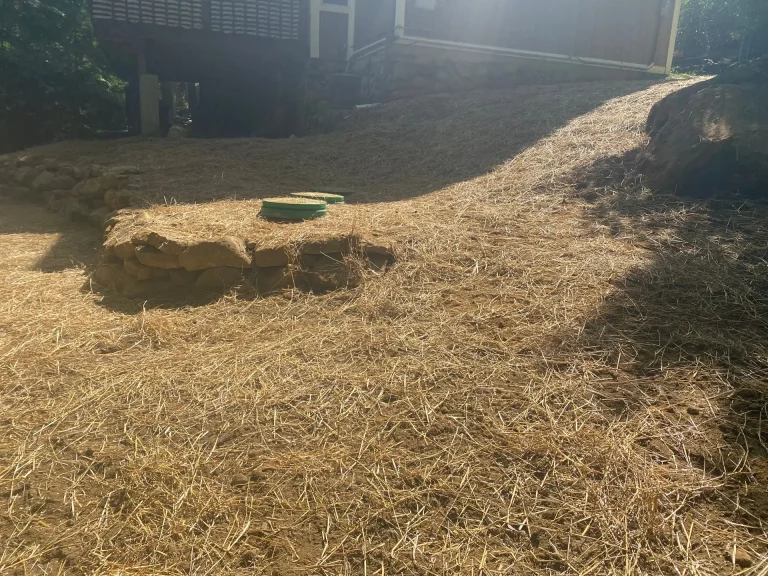 EPA guidance is direct: do not park or drive on your drain field, which is not designed to handle vehicles or heavy equipment. The agency’s earlier fact sheet adds that soil compaction can result in premature failure of the system.
Construction does the same damage. The fact sheet notes that building in wet soil causes puddling, smearing, and compaction that greatly reduce soil permeability and the life of a system. If you are planning a garage, an addition, or a patio, the EPA says not to build in or on the drain field area without checking with a local designer or permitting authority first.
Winter brings its own version of this problem. Our post on protecting your drainfield during snow removal and landscaping covers plows, trucks, and the other heavy loads that end up crossing a field.
Roots and a Tilted Distribution Box
The EPA recommends planting trees an appropriate distance from the drain field so roots stay out of the system. It also advises against trees, shrubs, or vegetable gardens on the field itself.
Frost works on the field from below. Our septic repairs page explains that frost heave in Sussex, Morris, and Warren counties often tilts distribution boxes, which sends uneven flow to certain trenches and overloads them. An overloaded trench can wear out well before the rest of the field.
Warning Signs a Drain Field Is Reaching the End
A failing drain field usually gives notice before sewage reaches the house. The signs tend to show up in the yard first, then at the drains, and they often get worse after heavy rain or a day of heavy water use. Catching them early is what keeps a repair on the table instead of a full replacement.
Soggy Ground and Greener Grass Over the Trenches
Our septic services page describes the late stage plainly: wet spots or standing water over the drain field even in dry weather, and lush, dark green grass where effluent is surfacing.
Not every wet spot means the field is finished. A field flooded by a downspout or a sloped yard can recover once the water source is fixed, which is the difference our biomat post explains.
Slow Drains and Gurgling Across the House
When the field cannot take more water, the wastewater has nowhere to go but back toward the house. Several slow fixtures at once, especially the lowest drains in the home, point to a problem past the individual fixtures.
Those same symptoms can come from a clogged effluent filter, which costs far less to fix than the field. That is why a diagnosis should come before anyone talks about replacement.
Sewage Odor Over the Field
A sewage smell in the yard, especially over the trenches, is another sign that effluent is reaching the surface. Our post on the 7 warning signs of drainfield failure walks through the full list in more detail.
How Drain Field Problems Are Diagnosed and Repaired
The repair-or-replace decision depends on why the field is struggling, not only on how old it is. An older field with a tilted distribution box may have years left, while a younger field sealed by biomat may not. The first job is finding out which one you have, before any money goes into the ground.
Our septic system repairs page describes how we find the exact failure point: dye testing, camera inspections, and component checks. The answer might be a clogged filter, a damaged baffle, a tilted distribution box, or the field itself.
Ruling Out the Inexpensive Fixes First
Some of the most common problems sit outside the soil. A clogged effluent filter, a worn baffle, or a distribution box knocked out of level by frost can all make a working field look like it is failing.
Distribution lines clogged by biomat or roots can sometimes be cleared with high-pressure water jetting. Our repairs page notes that success rates are highest on systems under 25 years old with localized blockages, rather than a field that has collapsed completely.
Restoring Soil That Is Compacted or Saturated
When the soil itself has become compacted or saturated, our repairs page describes TerraLift soil fracturing. High-pressure air injections fracture compacted soil layers and reopen drainage pathways without excavation, and the page notes it works well in glacial till soils where compaction, not only biomat, is behind the failure.
Resting a field is the other restoration path. University of Kentucky Extension explains that resting the soil treatment area for six to twelve months can renovate a thick biomat by cutting off its food supply. That needs somewhere else for the household’s wastewater to go in the meantime, such as a second soil treatment area used in rotation.
When Replacement Is the Only Answer
 Maryland Extension is blunt about this: once a drain field malfunctions or fails, it typically cannot be repaired. Because good percolation needs natural or undisturbed soil, a new field may have to be built in a new location.
In Wantage, that new location still has to meet the four-foot zone of treatment. Our septic installation page notes that shallow water tables often call for mounded drain field designs, and that advanced treatment units can cut the required field size by 50% or more. Our page on septic engineering and design explains when a failed field calls for engineered plans.
The ranges below come from our septic repairs page. They are typical ranges, not a quote, and soil, rock, and system type change every job.
| Method | Typical Range | Best For |
|---|---|---|
| Baffle replacement or effluent filter cleaning | $300 to $1,200 | Solids escaping the tank, or a clogged filter that looks like field failure |
| Distribution box leveling | $800 to $1,500 | Uneven flow from a box tilted by frost heave |
| TerraLift soil fracturing | $3,500 to $6,000 | Compacted or saturated soil, caught before the field fails outright |
| Partial drain field restoration | $5,000 to $12,000 | Damage limited to part of the field |
| Complete drain field replacement | $15,000 to $35,000+ | A field that has failed and cannot be restored |
What This Means for Your Wantage Home
A drain field that has passed 20 years is not automatically finished, and a younger one is not automatically safe. What decides it is the condition of the soil under the trenches, and that takes a real diagnosis, not a guess based on the age of the house.
At Excavating New Jersey LLC, we start with the diagnosis, explain what we found, and tell you plainly whether a repair will hold or the field needs replacing. If the work is tied to a home sale, we offer pay-at-closing and can supply the scope and price a lender needs for a 203K loan.
To get a firm quote that holds to closing day, call us at (973) 702-0655.
Frequently Asked Questions
How Long Does a Septic Drain Field Last in Wantage?
A properly maintained drain field typically lasts more than 20 years, according to the EPA, and Nebraska Extension puts a well-designed and well-maintained system at 20 to 40 years or more. In Wantage, rock and seasonal high water limit where a replacement can go, so protecting the field you have is worth the effort.
How do you know if your drainfield is bad?
Common signs are soggy ground or standing water over the field in dry weather, unusually green grass over the trenches, slow drains across the house, and sewage odor in the yard. A clogged effluent filter can cause similar symptoms, so a diagnosis should come before any replacement quote.
What is the average cost to replace a septic drain field?
Our septic repairs page lists complete drain field replacement at $15,000 to $35,000 or more, depending on system type, soil conditions, and whether advanced treatment is required. Treat that as a typical range, not a quote, since rock and site access change every job.
Can a septic field last 50 years?
It is possible, but it is beyond the published ranges. The EPA describes more than 20 years for a properly maintained field, and Nebraska Extension gives 20 to 40 years or more. How long yours lasts depends on the soil, your water use, and how well solids are kept out of it.
Can a leach field be repaired?
Sometimes, if the problem is caught early. A tilted distribution box, a clogged filter, or compacted soil can be corrected without replacing the field. Maryland Extension notes that once a field has truly failed, it typically cannot be repaired and may need a new location.
Can you drive over a leach field?
No. The EPA says not to park or drive on a drain field, because it is not designed to handle vehicles or heavy equipment. Soil compaction can also cause the field to fail early.
What shortens the life of a drain field?
The biggest factors are solids escaping the tank, too much water at once, compaction from vehicles or construction, and tree roots. Roof drains and other rainwater aimed at the field add water the soil has to absorb on top of the household’s own.
Can a new drain field fit on a small or rocky Wantage lot?
It depends on the soil, and it takes design work. New Jersey requires four feet of suitable soil below the field, though that zone can be reduced to 18 inches at the administrative authority’s discretion when the design includes an advanced pretreatment unit. Mounded designs are another option where the water table is shallow.
 How Do I Know If My Sewer Line Needs Replacing in Wantage, NJ?