
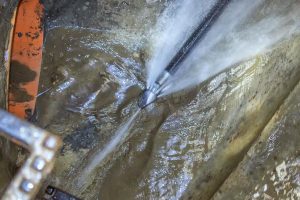
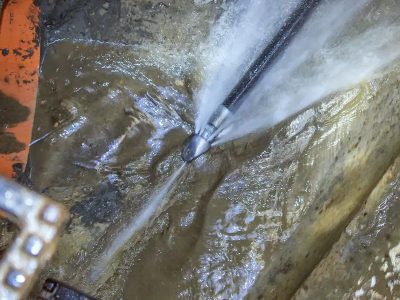
Hydro jetting is drain cleaning done with water pressure instead of a steel cable. A hose fed into the line sprays water at 1,500 to 4,000 PSI through a directional nozzle, scouring grease, roots, and sludge off the full inside wall of the pipe. A snake punches through a blockage. Jetting removes what the blockage was made of.
The price gap between those two jobs is where most homeowners get stuck. HomeGuide’s 2026 cost data puts the national average for hydro jetting at $1,000, with most jobs running $600 to $1,400. Snaking a sewer line, by the same source, usually lands between $200 and $500. On paper the cheaper option wins.
It stops looking cheaper the third time you pay for it. That is the honest version of the question, and it is the one worth answering: not what jetting costs, but what you get for the difference, and how to tell whether your line is the kind that will actually hold.
Here at Excavating New Jersey LLC, we have spent nearly 20 years working on septic systems and the lines that feed them across Sussex and Morris counties, and our owner Mike White is a NAWT-certified septic inspector. We run a camera down the line before the hose goes in, every time, because the pipe decides what the right answer is.
If a line at your place has backed up more than once, contact us and we will look at what is actually happening in the pipe before anyone quotes you a cleaning.
Quick Summary
- National context: HomeGuide puts hydro jetting at a $1,000 average for 2026, with most jobs between $600 and $1,400 and a full range of $300 to $3,000.
- The cheaper option: snaking a sewer line runs about $200 to $500 by HomeGuide’s 2026 figures, but it clears a path, not the buildup.
- The expensive option: replacement runs $50 to $250 per linear foot, roughly $2,000 to $10,000 for a 40-foot run.
- What moves your number: how bad the blockage is, where it sits, whether the line is reachable, and what the pipe is made of.
- The Sussex County wrinkle: freeze-thaw ground movement creates low spots in laterals that a cable passes straight over.
- The deciding factor: what a camera finds first. Jetting a structurally failed pipe is money spent on a problem it cannot fix.
What Does Hydro Jetting Actually Cost, and Why Do the Published Numbers Vary So Much?
The published ranges are wide because they cover very different jobs under one name. HomeGuide’s 2026 data puts the national average at $1,000, with a typical range of $600 to $1,400, a low end around $300, and the hardest jobs reaching $3,000.
Four things move a job inside that band, and HomeGuide names them plainly: how severe the clog is, where in the system it sits, how accessible and what condition the pipe is in, and local labor rates.
Access is usually the quiet one. A line with an existing cleanout can be jetted from a fitting that already exists. A line without one has to be opened somewhere, and that work happens before a drop of water moves.
Distance matters in the same way. A short run from a house to a septic tank is a different job from a long lateral crossing a yard, even when the blockage itself is identical.
None of these numbers are a quote. We publish no price list, because a number given before anyone has seen the pipe is a guess wearing a decimal point. What we do give is a flat rate before the work starts, covering the camera inspection, the jetting, and the documentation, so the figure you agree to is the figure you pay.
How Does Jetting Compare to the Cheaper Option and the Expensive One?
Cost only means something next to the alternatives. There are three realistic paths for a line that is backing up, and they sit at very different price points for very different outcomes. The right one depends on what is actually inside your pipe, which is why the comparison below follows the pipe, not the price.
What the lower price actually buys
A cable clears a channel through the obstruction. Flow returns, sometimes within minutes, and by HomeGuide’s 2026 figures the job runs $200 to $500 on a sewer line.
What it leaves behind is the buildup on the pipe wall. A lateral that has been snaked is still lined with grease, with only a narrow channel cut through the middle. That opening closes again at the rate it closed the first time.
What the higher price actually buys
Jetting works the full diameter. Water at up to 4,000 PSI, driven through a rotating nozzle, strips grease, scale, biofilm, and root material off the wall and flushes it out of the system instead of pushing it farther down the line.
For roots specifically, a cutting nozzle severs the intrusion at the joint and a scouring nozzle clears what is left. Chemical root treatments kill the growth without removing the mass, which is why lines treated that way often block again on the dead material.
What replacement costs when cleaning is no longer the question
If the pipe itself has failed, cleaning it is not a saving. HomeGuide puts sewer line replacement at $50 to $250 per linear foot, or roughly $2,000 to $10,000 for a 40-foot run.
That is the number a camera exists to help you avoid, or to face early enough that you can plan for it. Either outcome beats paying twice for a cleaning that was never going to hold. Our guide to the signs a sewer line needs replacing covers when that point arrives.
Why Does Sussex County Ground Change the Answer?

Northwest New Jersey does something to buried pipe that national averages do not account for. Our freeze-thaw cycles move soil vertically through the season, and a lateral that was laid on grade settles unevenly over years into low spots. Waste sits in those sags instead of flowing through.
A cable rides straight over a belly. It is a rigid tool following the top of the pipe, and it will report a cleared line while the low spot stays exactly as full as it was. Water does not have that problem, because velocity lifts settled material up and out of the dip.
Pipe material is the second local factor. Many homes here built between the 1940s and 1972, when production ended, ran Orangeburg, a tar-impregnated fiber pipe that tends to flatten under soil pressure as it ages. Clay and cast iron are both common in the same housing stock. Each takes a different pressure, which is why the nozzle and the PSI are set after the pipe is identified, never before.
There is a regulatory piece as well. Material flushed out of a line has to go somewhere, and it has to be handled and disposed of properly, not left in the yard. It is a step that adds nothing visible to the job and quite a lot to doing it right.
The ground is not uniform even inside one township, which is worth understanding before you compare quotes. You can see how that plays out in our work in Wantage Township, where bedrock comes up close to the surface toward the ridge while the valley bottomland carries a seasonal high water table. On rocky or sloped ground, the trenchless versus excavation choice comes up quickly once a line needs more than cleaning.
How Do You Tell Whether Jetting Is Worth It on Your Line?
The answer is rarely about the price. It is about whether the thing causing your backups is the kind of thing pressure can remove. A camera answers that before any money is spent, and three things decide it: the history of the blockage, the age and material of the pipe, and what the footage shows.
The history of the blockage
One backup after a heavy holiday weekend is a different signal from a backup every four months. A line that has been cleared before and closed again is telling you the material is still on the wall. If you are not sure whether the problem is the main line or the septic system, our guide to telling a clogged main line from septic failure sorts that out first.
Repeat frequency is the strongest single indicator that a cable is not reaching the problem. If you have paid for the cheaper fix twice, the cheaper fix has already cost more than the thorough one.
The age and material of the pipe
Older lines are not automatically unsuitable. Pressure calibrated to clay or cast iron cleans them safely, and doing that well is ordinary work.
Orangeburg is the real exception. A pipe that has already deformed under soil load is structurally compromised before anyone touches it, and no cleaning restores a collapsed section. Our post on older pipe in Northern NJ homes covers how to spot it.
What the camera finds before the hose goes in
We never jet blind. A sewer camera inspection identifies the pipe material, locates the blockage by distance, and shows whether the wall is intact. Our guide to how long a sewer camera inspection takes explains what the visit involves.
That single step decides everything after it. Where the line is sound and coated, high-pressure water jetting for septic lines is the job. Where the camera finds a crack, an offset joint, or a collapsed run, the honest answer is septic system repairs instead, and we will say so instead of selling you a cleaning that cannot work.
Where Wantage Homeowners Should Start
Most people asking about jetting are not comparing services. They are trying to work out whether the last backup was bad luck or the start of a replacement bill. The good news is that one visit usually settles it, and it settles it with footage, not guesswork.
A camera answers that in an afternoon, and the answer costs far less than guessing wrong in either direction. Sometimes it shows a greased line that will run clean for years after one pass. Sometimes it shows a pipe that needs replacing, and knowing that now is worth a great deal more than discovering it during a home sale.
Either way you get a flat rate before the work begins, before-and-after footage you can hand to a buyer or an agent, and a straight answer about what the pipe is actually doing. That is what we mean by no surprises here at Excavating New Jersey LLC.
Call us at (973) 702-0655 and we will get a camera in the line before anyone talks about pressure.
Frequently Asked Questions
Is hydrojetting worth the cost in Wantage?
It is worth it when the blockage is made of something pressure can remove and the pipe is sound enough to take it. That covers most grease buildup, sludge, scale, and root intrusion in intact clay, cast iron, or PVC lines. It is not worth it when the pipe has structurally failed, because cleaning a cracked or collapsed line does not restore it. The way to tell the difference is a camera inspection first, and around here the case for jetting is often stronger than the national averages suggest, because freeze-thaw ground movement creates low spots that a cable cannot clear at any price.
How much does hydro jetting cost?
HomeGuide’s 2026 data puts the national average at $1,000, with most jobs between $600 and $1,400 and a full range of $300 to $3,000. Your figure depends on how bad the blockage is, where it sits, how reachable the line is, and what condition the pipe is in. We work on a flat rate agreed before the job starts, not an hourly clock.
Is hydro jetting safe for old pipes?
Yes, when the pressure is matched to the material. Clay and cast iron are jetted routinely at calibrated settings, and what matters is structural condition, not the year the line went in. The exception in this area is Orangeburg, the fiber pipe used in homes from the 1940s until production ended in 1972, which tends to flatten under soil pressure as it ages. A camera inspection identifies the material and the wall condition before any pressure is chosen, which is why we do not skip that step.
Can hydro jetting damage pipes?
It can, if it is done without knowing what is in the ground. Running high pressure into a pipe that is already cracked, offset, or deformed can turn a repairable defect into a failure. That is the risk in hiring on price alone, because the camera inspection is the step that usually gets cut. Done properly the sequence is fixed: inspect, identify the material, calibrate the pressure and the nozzle, then jet, and where that inspection shows the line cannot safely take it, the correct call is to stop and talk about repair.
How long does hydro jetting last?
It depends entirely on what caused the blockage. Grease buildup from normal household use can stay clear for years after a full-diameter clean, particularly if kitchen habits change alongside it. Root intrusion is different, because the tree is still there and the joint is still the easiest water source in the yard, so regrowth is a matter of time. A structural problem is not solved at all by cleaning, which is why the post-jetting footage matters: it shows what condition the wall was actually in.
Is hydro jetting better than snaking?
They do different jobs, so better depends on the problem. A cable is fast and cheap and it restores flow by punching a path through an obstruction, which is genuinely the right tool for a single foreign object or a one-off clog. Jetting clears the full inside diameter, so it removes the material the blockage was made of instead of tunneling through it. If a line keeps closing after being snaked, that pattern is the answer: the buildup is still on the wall and a cable is not reaching it.
How long does hydro jetting take?
A straightforward residential line with an accessible cleanout is usually a same-visit job of a few hours, including the camera work before and after. What stretches it is access: a line with no existing cleanout has to be opened first, and a blockage that has to be located and marked above ground adds time before any cleaning starts. Severe root masses often need multiple passes with different nozzles. We would rather give you a realistic window once the camera has been down than a number over the phone.
Does hydro jetting work on roots?
Yes, and it is one of the clearest cases for it. A cutting nozzle severs roots at the pipe collar where they enter, then a scouring nozzle removes the remaining organic material and biofilm, which physically extracts the mass instead of leaving it in the line. Chemical root treatments work differently: they kill the growth but leave it in place, which is why lines treated that way sometimes block again on dead material. Roots do return, since the joint they found is still there, so the camera footage matters for planning what happens next.
 How Long Does a Sewer Camera Inspection Take in Wantage?
