
Written by Mike | Owner & Master Excavator, Excavating New Jersey LLC | NAWT-Certified Septic Inspector | Nearly 20 Years Serving Sussex County, NJ
Quick Summary
- A single slow drain usually points to a localized clog. Multiple drains backing up at once — especially at the lowest fixtures — points to either a main line blockage or a septic system problem.
- The fastest way to isolate the cause is the Cleanout Cap Test: open your two-way cleanout and check the water level. What you see there tells you almost everything.
- This guide walks you through a step-by-step diagnostic method so you can call the right professional with the right equipment — and avoid paying for the wrong fix.
Water is backing up in your shower. Your toilet is making a sound like a coffee maker. And you’re standing in your bathroom at 7 PM, wondering if you need a plumber with a snake or an excavator with a pump truck.
Here’s the honest answer: those two problems have almost opposite solutions, and calling the wrong one first can cost you hundreds of dollars in service fees before you’ve fixed anything.
This guide gives you a clear, methodical way to figure out which problem you’re actually dealing with — before you pick up the phone.
Why Getting the Diagnosis Right Matters So Much
Let’s put the stakes on the table.
A clogged main sewer line — caused by grease buildup, wipes that shouldn’t have been flushed, tree roots, or a pipe belly — can often be cleared with hydro-jetting or a mechanical snake. We’re typically talking a few hundred dollars.
A septic system failure — whether it’s a full tank, a blocked inlet baffle, a tipped distribution box, or a saturated drainfield — is a different animal entirely. Depending on what’s failed, you could be looking at a pump-out, a component repair, or, in the worst case, a full signs-of-septic-drainfield-failure scenario that requires system replacement.
The cost gap between those two outcomes? Potentially tens of thousands of dollars.
That’s why the first 20 minutes of diagnosis are the most valuable 20 minutes of this whole situation.
Step 1: Read Your Symptoms — Location and Pattern Are Everything
Before you touch anything, do a quick walkthrough of your home and answer these two questions.
Which fixtures are affected?
- One fixture only (one sink, one toilet, one shower): Almost always a localized clog in that fixture’s branch line. This is the least serious scenario.
- Multiple fixtures on the same floor or throughout the house: This points further down the system — either your main line or your septic system.
- The lowest fixtures in the house are the first to back up (basement floor drain, first-floor toilet): This is a classic sign that something is blocking outflow from the house entirely — main line or septic.
What’s the pattern of the backup?
- Constant slow drainage, getting worse over time: Suggests a partial mechanical blockage — grease cap, root intrusion, or pipe sag — in the main line.
- Backups that happen specifically during heavy water use (running the dishwasher, doing laundry): This is a strong indicator of a hydraulic load problem — your septic tank may be full, or your drainfield may be saturated and can’t accept water fast enough.
- Gurgling sounds from toilets or drains when you run water elsewhere: The system is trying to breathe. Air is being displaced somewhere it shouldn’t be.
Think of it this way: Your plumbing is like a two-lane highway. The main line is the on-ramp. The septic system is the highway itself. A clog on the on-ramp backs up your house. A problem on the highway backs up everything.
Step 2: Check the Yard — Don’t Skip This
Walk your property before you do anything else inside. This takes three minutes and can save you a lot of guesswork.
What you’re looking for:
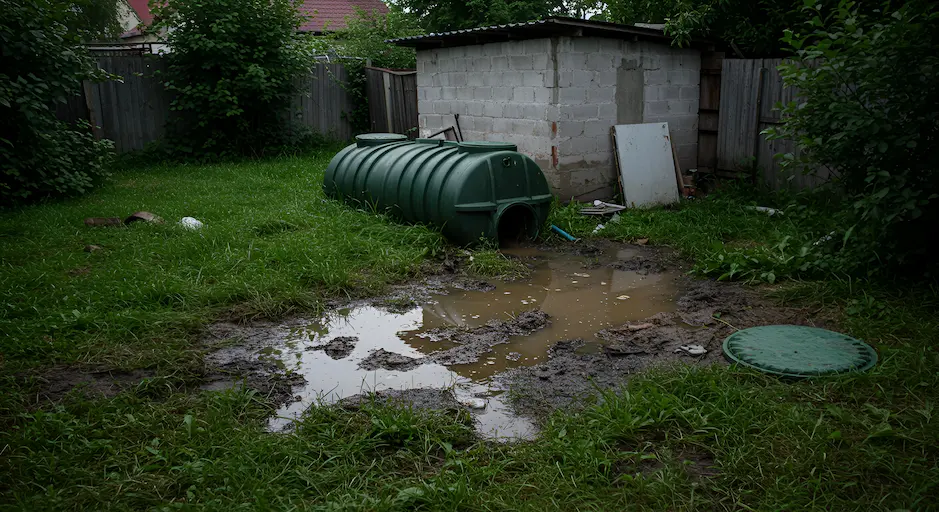
- Soggy, spongy ground over your drainfield area — especially if it hasn’t rained recently. This is effluent surfacing, and it’s a serious sign of field saturation or failure.
- Unusually lush, green grass in a specific patch of your yard (your neighbors’ grass is brown; yours is inexplicably thriving). Effluent is a fertilizer. That patch is telling you something.
- Standing water or a sewage odor near the tank or field area. This is not a “wait and see” situation.
Now, here’s the important nuance for Sussex County homeowners specifically: after significant rainfall or during spring thaw, a temporarily soggy drainfield doesn’t always mean permanent failure. Clay-heavy soils and high-water-table properties near the watershed areas of northern NJ can cause short-term hydraulic overload. The system may recover. But if the sogginess is persistent — or if it’s accompanied by indoor backups — that changes the calculus entirely.
If your yard looks completely normal and dry, that’s actually useful information. It shifts suspicion back toward the main line.
Step 3: The Cleanout Cap Test (This Is the One That Matters)
This is the diagnostic step that professional inspectors use in the field, and it’s something you can do yourself in under five minutes. It will tell you, with a high degree of certainty, whether your problem is upstream (inside your house plumbing/main line) or downstream (the septic tank and field).
What you need: Your main line cleanout location. This is typically a white or black PVC cap (sometimes cast iron on older homes) located outside your foundation, near where your sewer line exits the house. Some homes have them inside near the basement floor. If yours is buried, look for a slight ground-level depression or a visible cap at grade.
What to do:
- Using a pipe wrench or channel-lock pliers, carefully remove the cleanout cap. Do this slowly — if the line is under pressure, water may discharge.
- Look at the water level inside the cleanout pipe.
Here’s what you’re reading:
| What You See at the Cleanout | What It Means | Who to Call |
| Pipe is empty or nearly empty | The clog is inside your house, between the cleanout and your fixtures. The main line to the septic tank is clear. | Plumber (snake or hydro-jet) |
| Water is sitting at or near the top of the pipe | Flow is blocked downstream — either the main line to the tank is clogged, or the septic system itself is full/backed up. | Septic specialist first |
| Water is actively flowing or trickling | Partial blockage somewhere downstream. | Septic specialist + camera inspection |
| Sewage is at the cap and ready to overflow | Full system backup — call immediately. | Emergency septic service |
This single observation collapses what could be a confusing multi-symptom puzzle into a clear directional answer. It’s the reason experienced technicians check the cleanout before they pull out any equipment.
If you’re not comfortable opening the cleanout yourself, that’s completely fine — just note its location so the technician can go straight to it when they arrive.
Step 4: The “Who to Call” Decision — A Plain-English Breakdown
Based on what you’ve observed in Steps 1 through 3, here’s how to route your call.
Call a Plumber First If:
- Only one or two fixtures are affected
- The cleanout is empty (clog is inside the house)
- You have a newer home on municipal sewer (no septic system)
- You recently flushed something you shouldn’t have
- There are no yard symptoms whatsoever
A plumber will likely use a mechanical snake or hydro-jetting to restore flow. On older homes with clay pipes, they may recommend a camera inspection to rule out root intrusion or a pipe belly.
Call a Septic Specialist First If:
- Multiple fixtures are backing up, especially at the lowest points
- The cleanout shows water sitting high or at the top
- Your yard is soggy over the drainfield
- Backups happen specifically during heavy water use
- You can’t remember the last time your tank was pumped (every 3–5 years is standard)
- You notice a sewage odor outside near the tank or field
A septic specialist will assess tank levels, check the inlet and outlet baffles, inspect the distribution box, and probe the field. If the tank just needs to be pumped, that’s a straightforward fix. If the field is showing signs of failure, you’ll want an honest assessment of what routine tank maintenance could have prevented — and what the repair path looks like from here.
Not sure which category you’re in? That’s exactly what a free site evaluation is for. At Excavating New Jersey, we’d rather come out and tell you it’s a simple plumber call than have you spend money on the wrong service. Call us at (973) 314-8746 and describe what you’re seeing — we can often help you triage over the phone.
The Remote Triage Checklist: What to Send Before We Arrive
If you’re calling a contractor — whether it’s us or anyone else — the single most useful thing you can do is send a few photos or a short video before the truck rolls. This lets the technician arrive with the right equipment, and it often means the problem gets solved on the first visit instead of requiring a return trip.
Here’s exactly what to capture:
- A photo of the cleanout cap and whether it’s accessible or buried
- A photo or short video of the affected fixture(s) — show the water level and any gurgling
- A wide shot of your yard over the drainfield area, showing any sogginess, discoloration, or surfacing
- Your septic tank access lid location, if you know where it is
- A quick note on: When did this start? Does it get worse with heavy water use? When was the tank last pumped?
That information tells a technician whether you are likely dealing with a full tank, a blocked line, or both. It saves time, and in a backup situation, time matters.
What If It’s Actually Both? (It Happens More Than You’d Think)
Here’s a scenario we see regularly in northern NJ, especially on properties that haven’t had routine tank maintenance in several years:
The main line has a partial blockage — maybe some root intrusion near an old oak tree — that’s been slowing drainage for months. Because flow is restricted, solids that would normally pass through are accumulating faster than usual in the tank. The tank fills up. Now you have two problems feeding each other.
In these cases, snaking the main line alone won’t fully solve the backup, and pumping the tank alone won’t solve the root intrusion. The correct sequence is: pump the tank first to relieve pressure, then camera-inspect the line to find the mechanical obstruction.
This is why a good diagnostic conversation before the first truck arrives matters so much. It’s not about upselling — it’s about not making two trips when one well-planned visit would have done it.
Conclusion: You Now Know More Than Most Homeowners
The difference between a $300 snake job and a $15,000 drainfield replacement isn’t always obvious from the inside of your bathroom. But with the Cleanout Cap Test, a yard walk, and a clear read of your symptom pattern, you can walk into that phone call knowing what you’re dealing with — and what questions to ask.
Quick recap:
- Single fixture = localized clog, call a plumber
- Multiple fixtures + cleanout full = septic system issue, call a specialist
- Soggy yard + indoor backups = potential drainfield failure, get an assessment now
- Not sure? The cleanout doesn’t lie
If you’re in Sussex County or anywhere in northern NJ and you want a straight answer from someone who’s been doing this for nearly 20 years — Mike and the team at Excavating New Jersey are here for exactly this. We offer free site evaluations, upfront pricing, and we’ll tell you honestly what you’re dealing with before any work begins.
Call (973) 718-5092 or reach out online for a free estimate. We’ll help you figure out the right next step — and make sure you’re not paying for the wrong one.
Frequently Asked Questions
How can I tell if my main sewer line is clogged or if my septic tank is full?
The fastest way is the Cleanout Cap Test. Locate your main line cleanout (usually a capped pipe near your foundation) and carefully open it. If the pipe is empty, the clog is inside your house. If water is sitting high in the pipe or near the top, the problem is downstream — either a main line blockage toward the tank, or the tank itself is full and not accepting flow. Multiple fixtures backing up simultaneously, especially at the lowest points in the house, also strongly suggests a septic issue rather than a simple interior clog.
Why does my shower gurgle when the toilet flushes?
Gurgling between fixtures is a sign that air is being displaced through the water in your drain traps — which means there’s a pressure imbalance in the drain system. This usually indicates a partial blockage somewhere in the shared drain line, a venting problem (blocked roof vent), or a main line that’s running at reduced capacity. It’s one of the earliest warning signs that a backup is developing, and it’s worth investigating before it becomes a full stoppage.
Does a soggy lawn always mean the septic drainfield has failed?
Not always — but it’s never something to ignore. In northern NJ, especially after heavy rainfall or during spring thaw, clay-heavy soils can become temporarily saturated, causing the drainfield to surface briefly. If the sogginess clears up within a few days after dry weather and you have no indoor symptoms, it may be a hydraulic overload event rather than permanent failure. However, if the wet area is persistent, has a sewage odor, is accompanied by indoor backups, or is occurring during dry weather, those are strong indicators of drainfield saturation or biomat formation — and you should have a certified septic inspector evaluate the system as soon as possible.
 What Does Bedrock Excavation Actually Cost in Sussex County, NJ? (The Honest Breakdown)