
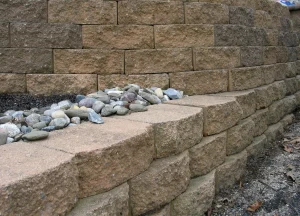
Boulder & Retaining Wall Construction NJ
Professional boulder and retaining wall construction for sloped properties in Sussex County and Northern NJ.
Get a Free Estimate
"*" indicates required fields
Sloped Property Creating Drainage and Erosion Problems?
We build engineered walls that prevent erosion, manage water pressure, and stabilize terrain—designed for New Jersey’s clay soils, freeze-thaw cycles, and drainage challenges.
Unstable slopes don’t just look bad—they threaten your foundation, driveway, and yard with erosion and water damage. Without proper slope stabilization, Northern New Jersey’s clay soils and freeze-thaw cycles will continue shifting and washing away. Amateur retaining wall construction fails within years because it ignores drainage engineering and soil mechanics.
- Walls without proper drainage fail from hydrostatic pressure buildup
- Shallow footings heave and tilt during freeze-thaw cycles
- Poor base preparation causes settling and structural collapse
- Walls over four feet require engineered plans and permits in NJ
We handle the complete process: site assessment, drainage system design, proper foundation excavation below frost line, and construction that accounts for New Jersey’s expansive clay soils and lateral earth pressure.
Licensed & Insured | Nearly 20 Years Experience | Free Site Evaluations
Professional Retaining Wall Solutions
Boulder Wall Construction
Native New Jersey trap rock and basalt walls built to resist lateral earth pressure on sloped terrain. These gravity walls use mass and proper batter (backward lean) to hold soil in place for 50+ years. Dry-stacked construction allows flexibility during ground movement without cracking, and the natural stone aesthetic blends with Northern NJ landscapes.
Segmental Retaining Wall Systems
Engineered interlocking concrete block walls for heights exceeding four feet or challenging soil conditions. SRW systems incorporate geogrid reinforcement that extends the effective mass deep into retained soil. Ideal for properties requiring engineered plans, uniform construction, and precise load distribution across multiple terraced levels.
Drainage System Installation
Hydrostatic pressure management prevents the leading cause of wall failure in New Jersey. We install perforated drainage pipe at wall base, clean crushed stone backfill (ASTM #57 spec), and weep holes every 4-6 feet to evacuate water before pressure builds. Filter fabric separates drainage zones from native clay to prevent sediment clogging.
Geogrid Reinforcement & Soil Stabilization
High-strength polymer mesh layers installed horizontally as walls are built, extending back into hillsides equal to wall height. Geogrid interlocks with soil particles to create composite structures stronger than either component alone. Required for walls over four feet, poor soil conditions, or surcharge loads like driveways at top of slope.
Foundation Excavation & Base Preparation
Footings excavated below frost line (42 inches in Sussex County) and filled with compacted crushed stone base course. Mechanical compaction to 95% density prevents settling that causes tilting and structural failure. Proper base width (typically one-half to two-thirds wall height) distributes lateral forces and ensures long-term stability.
Why Excavating New Jersey LLC for Retaining Walls
Serving Sussex County and Northern NJ since 2006
We’re the excavation and site work specialists homeowners trust when slopes threaten property, drainage systems fail, or erosion damages foundations and driveways.
Licensed, insured, and experienced with NJ building codes
We understand the four-foot threshold that triggers engineering requirements, municipal permit processes in Vernon, Sparta, Wantage, and Newton, and Soil Conservation District reviews for steep slopes. Your wall is designed for site-specific soil conditions—not generic assumptions.
We engineer for New Jersey’s geology
Sussex and Morris County glacial till requires deeper footings and aggressive drainage. Piedmont red clay soils create cyclical pressure during wet/dry cycles. We account for the 80-100 freeze-thaw cycles per season that create hydrostatic pressure and frost heave—the forces that destroy improperly built walls within five years.
The difference: we build drainage systems, not just walls
Failed retaining walls rarely have structural problems with the stone or block itself. They fail because water trapped behind the wall creates 300-400% more pressure than design loads. Our walls include perforated pipe, clean stone drainage planes, and weep holes as standard—not optional add-ons.
Related Services

Driveway Installation
Trusted Excavation & Site Preparation for Long-Lasting Driveways When your driveway installation in New Jersey …
Foundation and Yard Drainage
Tired of standing water, wet basements, and foundation problems? Excavating New Jersey provides complete yard drainage …
Lot & Land Clearing NJ
Overgrown Property Holding You Back? From forestry mulching to precision grading, we transform overgrown property into …
Ready to Stabilize Your Sloped Property?
Free site evaluations and upfront pricing for retaining wall construction in Sussex County, Vernon, Sparta, Wantage, Newton, Hopatcong, and surrounding areas.
Your reliable excavation and site work provider in Northern New Jersey.
Get a Free Estimate Today
Frequently Asked Questions
How deep should a retaining wall foundation be in New Jersey?
The foundation must extend below the frost line to prevent heaving. In northern New Jersey (Sussex, Morris, Warren counties), this means 42 inches minimum. In southern counties, 36 inches is typically sufficient. Taller walls or those on poor soil may require deeper foundations as specified by engineering analysis.
Do I need a permit for a retaining wall in New Jersey?
Walls under four feet of retained height typically require only a standard building permit. Walls four feet or taller require engineered plans with a Professional Engineer’s seal. Some municipalities have additional requirements for walls on steep slopes or near property lines. Always check with your local building department before beginning construction.
What causes retaining walls to fail?
Walls under four feet of retained height typically require only a standard building permit. Walls four feet or taller require engineered plans with a Professional Engineer’s seal. Some municipalities have additional requirements for walls on steep slopes or near property lines. Always check with your local building department before beginning construction.
How long do boulder retaining walls last?
Walls under four feet of retained height typically require only a standard building permit. Walls four feet or taller require engineered plans with a Professional Engineer’s seal. Some municipalities have additional requirements for walls on steep slopes or near property lines. Always check with your local building department before beginning construction.
What is the best drainage system for retaining walls?
Walls under four feet of retained height typically require only a standard building permit. Walls four feet or taller require engineered plans with a Professional Engineer’s seal. Some municipalities have additional requirements for walls on steep slopes or near property lines. Always check with your local building department before beginning construction.
How much does a retaining wall cost in New Jersey?
Costs vary significantly based on height, materials, site access, and drainage requirements. Boulder walls typically range from $40-80 per square foot of wall face. Segmental block systems run $30-60 per square foot. Walls requiring engineering, geogrid reinforcement, or difficult site access cost more. Proper drainage systems add $15-25 per linear foot but are essential for longevity.
Can I build my own retaining wall?
Walls under three feet on stable, well-drained soil are reasonable DIY projects for experienced homeowners. Taller walls, walls on poor soil, or walls retaining steep slopes should be engineered and constructed by professionals. Improper construction can result in failure causing property damage, injury, and legal liability. Building permits are required regardless of who does the work.
What is geogrid reinforcement and when is it needed?
Geogrid is a high-strength polymer mesh that interlocks with soil to create a composite structure stronger than either component alone. It’s typically required for walls over four feet, walls on poor soil, or walls with surcharge loads (like driveways) at the top. Geogrid layers are installed horizontally as the wall is built, extending back into the hillside a distance equal to or greater than the wall height.
What’s the difference between a gravity wall and a reinforced wall?
Gravity walls rely solely on their mass and weight to resist soil pressure. They work well for shorter walls (under four feet) and include boulder walls and dry-stacked stone. Reinforced walls use geogrid or mechanical anchoring to extend the effective mass deep into the retained soil, allowing taller walls with less face material. The choice depends on height, soil conditions, and site constraints.
How do I maintain a retaining wall?
Inspect weep holes annually and clear any blockages. Ensure surface drainage directs water away from the top of the wall. Check for signs of movement (bulging, tilting, separation between courses) and address issues promptly. Keep vegetation growth controlled—tree roots can destabilize walls over time. Well-constructed walls require minimal maintenance if drainage systems remain functional.
Fill Out The Form to
For a Free Estimate
"*" indicates required fields